Address
304 North Cardinal
St. Dorchester Center, MA 02124
Work Hours
Monday to Friday: 7AM - 7PM
Weekend: 10AM - 5PM
Address
304 North Cardinal
St. Dorchester Center, MA 02124
Work Hours
Monday to Friday: 7AM - 7PM
Weekend: 10AM - 5PM
Why you keep feeling empty — even when life looks fine.
From the outside, your life appears complete. A steady job, a comfortable home, people who care about you, plans that move forward, health that holds steady. By all reasonable measures, nothing is broken. Yet in the quiet hours—when the phone stops buzzing, when the tasks are done, when the lights dim—a hollow ache rises from somewhere deep inside you. You ask yourself, “Why am I not satisfied? What is missing?”
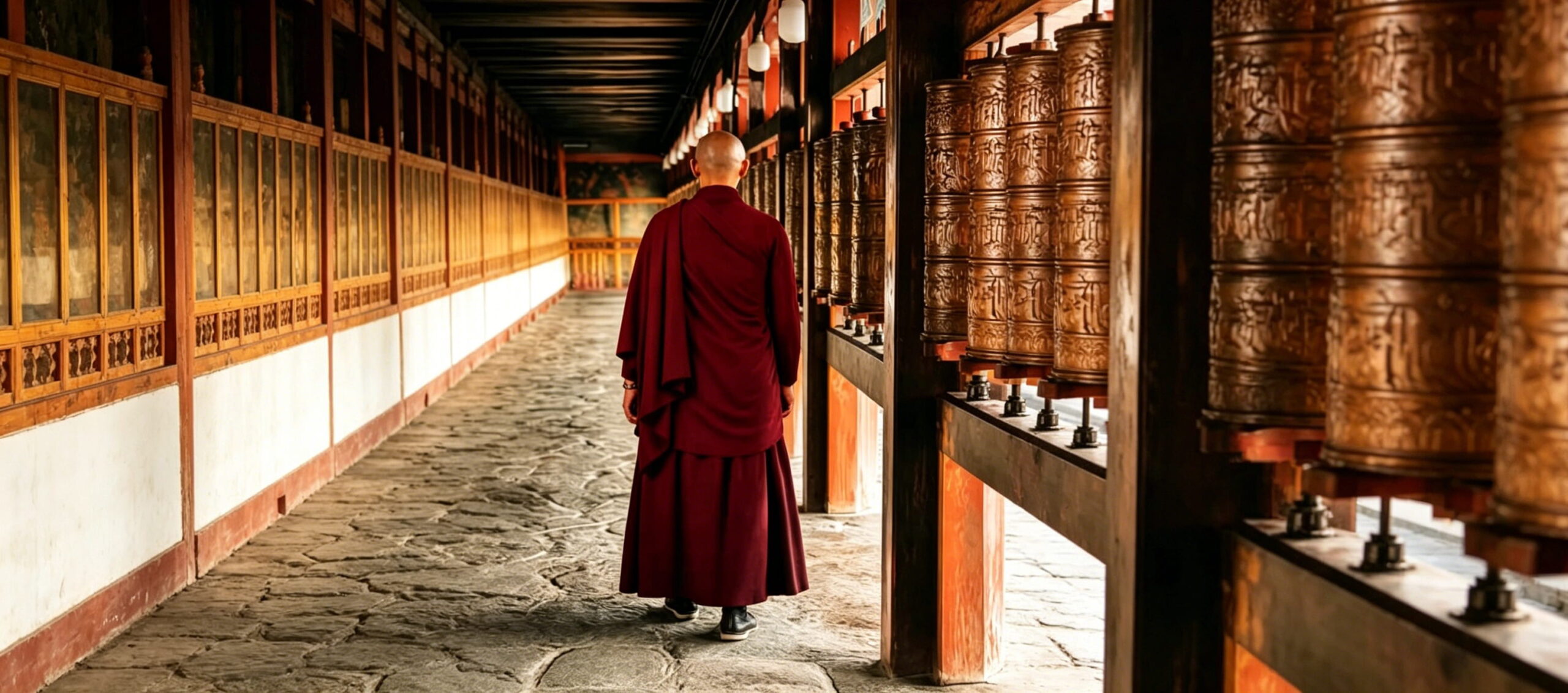
The monk, sitting silently on his worn wooden platform, hears this question every day from visitors who come with full wallets and empty hearts. He does not dismiss their emptiness as a problem to be fixed. Instead, he bows to it, because he knows a truth that the world has forgotten: that very emptiness is not a wound—it is a doorway.
In the monastery, we are taught that the mind is like a cup. The world tells you to fill this cup with achievements, possessions, relationships, and pleasures. And so you run from one filling to the next, believing that the next drop will finally make the cup overflow with contentment. But the monk watches your frantic filling with gentle pity, because he sees the cup has a tiny crack at the bottom—the crack of impermanence. No matter how much you pour in, it slowly drains away. That is why your emptiness persists, even when life looks fine. The finer the life, the faster you pour; the faster you pour, the more you notice the draining.
But here is the monk’s radical secret: the cup is not meant to be filled. It is meant to be turned upside down and emptied completely. Only when all the stale water of expectations, comparisons, and borrowed desires is poured out does the cup become truly useful—not for holding temporary liquids, but for reflecting the vast, clear sky above. Your emptiness is not a lack; it is a spaciousness. You have been mistaking a cathedral for a storage room.
When life looks fine, the ego panics because it has no obvious enemy to fight and no urgent lack to fill. It creates phantom hungers—scrolling endlessly, shopping pointlessly, overthinking ceaselessly—just to feel alive. The monk, however, delights in these ordinary moments of fine-ness. He sits in the middle of a perfectly unremarkable afternoon and feels the breeze on his skin, the pulse of his breath, the sound of a distant bird. He does not need the world to be spectacular or painful to feel real. He is real because he has stopped asking the world to confirm his reality.
That hollow ache you feel is actually the voice of your true nature, calling you home. It is not telling you, “Get more.” It is telling you, “Let go of more.” Let go of the need to understand everything, to control everything, to impress everyone. Let go of the story that you must be special, extraordinary, or even happy all the time. When you release these heavy burdens, the emptiness transforms. It is no longer a cold, lonely void—it becomes a warm, open silence, as vast as the space between stars, and just as full of mysterious life.
The monk would say to you: Do not fear your emptiness. Befriend it. Sit with it without trying to fill it. In that sitting, you will discover that what you were searching for in the world was never outside you—it was the very awareness that is now reading these words, that is now feeling this moment, that is now knowing itself. That awareness needs no external decoration. It is complete, radiant, and utterly at peace—precisely because it is empty of all clinging.
So the next time the hollow ache rises, do not reach for your phone, your snack, your plan, or your escape. Simply breathe into that ache. Let it be. The monk smiles, because he knows: when you stop trying to fill your emptiness, the emptiness finally has room to fill you—with the only thing that can never be drained away: the silence of pure being.